
APEC Cuts Asia-Pacific Growth Forecast to 3.1% as Foreign Investors Dump Record $17.27bn in Asian Equities
On May 21, 2026, APEC’s Policy Support Unit released its latest economic report ahead of the APEC Trade Ministers’ Meeting, downgrading the 2026 Asia-Pacific growth forecast from 3.3 percent to 3.1 percent, with a further slowdown to 3.0 percent projected for 2027.
ASIA,ECONOMY
Global N Press
5/21/20262 min read
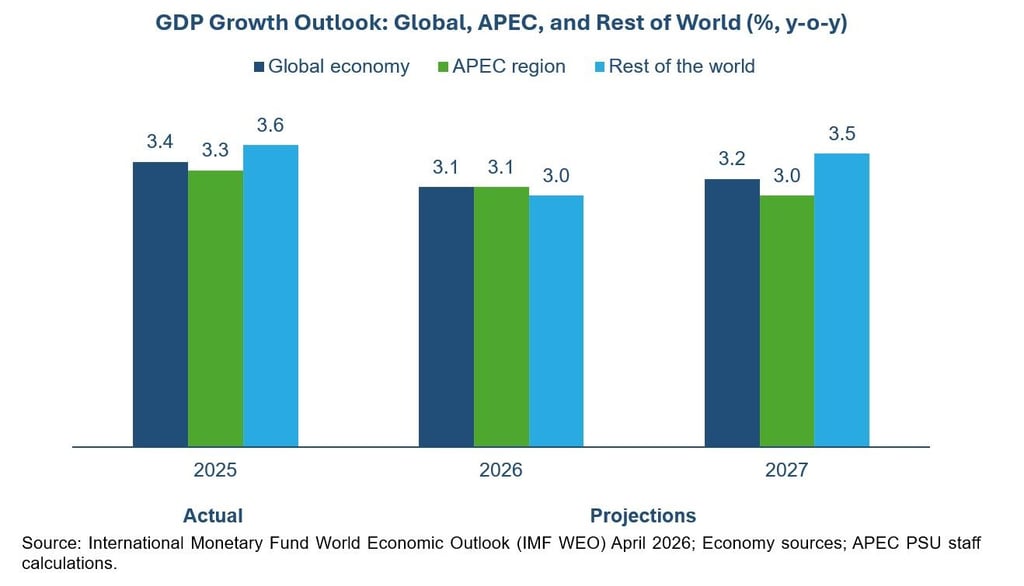
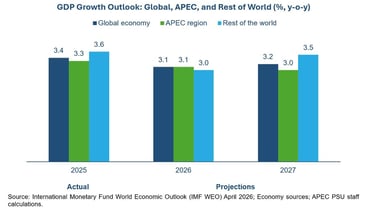
On May 21, 2026, APEC’s Policy Support Unit released its latest economic report ahead of the APEC Trade Ministers’ Meeting, downgrading the 2026 Asia-Pacific growth forecast from 3.3 percent to 3.1 percent, with a further slowdown to 3.0 percent projected for 2027. More than half of APEC member economies are experiencing decelerating output expansion. APEC PSU Director Carlos Kuriyama stated at a media briefing that while short-term resilience persists, the cascading effects of energy price shocks, weakening demand, intensifying supply chain disruptions, and narrowing policy space are casting a “shadow” over the medium-term outlook. Data show that oil and natural gas account for 49 percent of APEC’s energy mix, with over 45 percent of crude oil and 23 percent of natural gas imported from the Middle East, rendering regional energy supply acutely vulnerable to disruptions in the Strait of Hormuz.
The shock has extended into food security—APEC imports 27 percent of its nitrogen-based fertilizers from the Middle East, and rising fuel costs combined with shipping disruptions are driving up prices of vegetable oils, grains, and meat. On the trade front, while merchandise export volumes surged 7.6 percent in 2025, the report projects this rate will plummet to between 3.3 and 3.7 percent during 2026-2028, as trade fragmentation deepens amid a sharp rise in tariffs and trade remedy measures. Meanwhile, data from the London Stock Exchange Group in mid-May revealed that foreign investors are exiting Asian equities at an unprecedented pace. Cumulative foreign net selling of Asian stocks reached 24.75 billion dollars in May, with a record 17.27 billion dollars sold in the single week of May 12-16—South Korea alone saw 13.14 billion dollars in outflows, Taiwan 2.88 billion dollars, and India 1.35 billion dollars.
The 30-year U.S. Treasury yield climbed to its highest since 2007, with elevated long-term financing costs exerting clear downward pressure on growth-oriented Asian equity valuations. The Asian Development Bank had already slashed its 2026 growth forecast for developing Asia from 5.1 percent to 4.7 percent. Adding a further structural dimension to the crisis, Japan’s Nikkei reported on May 20 that Asian economies are making an emergency return to coal: Thailand’s electricity authority is reactivating two mothballed coal-fired generating units, India has ordered maximum operation at coal plants, and a major Vietnamese conglomerate canceled plans for a liquefied natural gas power plant. Coal currently accounts for around 50 percent of Asia’s electricity mix, and key producers China, India, and Indonesia can supply it domestically—making coal the most readily available short-term hedge against an energy shock that shows little sign of abating.