
Chinese Universities Reach the Global Peak of Research Output: Zhejiang University Tops a Key Indicator in the Leiden Ranking
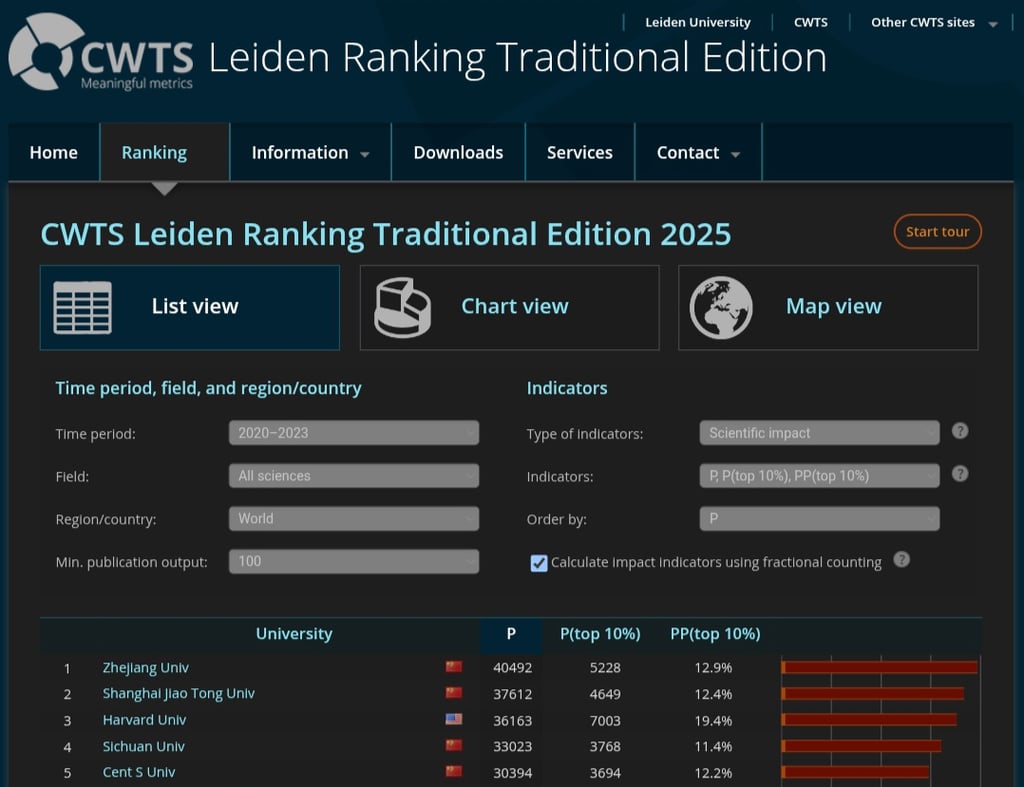
In the newly released CWTS Leiden Ranking 2025, Zhejiang University ranks first in the world on one of the most fundamental and rigorous indicators: total number of scientific publications (Publication Count, P).
CHINA,POLITICS
Global N Press
1/21/20262 min read

In the global system of research evaluation, Chinese universities have long been seen as “fast followers.” That pattern has now undergone a historic shift.
In the newly released CWTS Leiden Ranking 2025, Zhejiang University ranks first in the world on one of the most fundamental and rigorous indicators: total number of scientific publications (Publication Count, P). It surpasses long-established research powerhouses such as Harvard University and Shanghai Jiao Tong University, becoming the world’s largest producer of academic papers by volume.
This marks the first time a Chinese university has stood at the very top of an internationally recognized research statistics system.
A Ranking Highly Respected in Academia
The Leiden Ranking is produced by the Centre for Science and Technology Studies (CWTS) at Leiden University in the Netherlands. Unlike comprehensive rankings such as QS or THE, it does not rely on reputation surveys or subjective scoring. Instead, it is built almost entirely on:
Web of Science data
Publication volume
Proportion of top-10% highly cited papers
International collaboration
Research impact
For this reason, it is often regarded as one of the rankings that most closely reflects “research itself.”
Under this strict, data-driven framework, Zhejiang University has steadily expanded its research output over recent years, eventually reaching the number-one position globally in the 2025 edition.
What Does This Mean?
This does not mean “Zhejiang University is the world’s best university overall.” But it does mean:
Chinese universities have, for the first time, led the world in a major global research indicator
China’s research system now has sustained, large-scale output capacity
Success is no longer based on a few star scholars, but on a system-level advantage
Behind this result lie years of investment in research infrastructure, talent development, disciplinary planning, and institutional capacity.
Zhejiang University covers high-output fields including engineering, medicine, information science, and agriculture. Its structure increasingly resembles a “super research system,” rather than a university dependent on isolated breakthroughs.
From Follower to Front Runner
For many years, Chinese universities were described in global rankings as “the fastest risers” or “the biggest improvers.”
This time is different.
It is the first moment when a Chinese university has truly stood at the very front of the global system—under the same data rules used for everyone else.
It does not mean the journey is over. But it does mean one thing has clearly changed:
Chinese universities are no longer only catching up with the world.
In some key indicators, they are now running side by side with the strongest—and in some cases, ahead.