
Middle East Conflict Sparks Eurozone Inflation Surge as March CPI Jumps to 2.5 Percent, EU Economy Faces Stagflation Risk
On March 31, 2026, Eurostat’s preliminary estimate put eurozone annual inflation at 2.5% in March, up from 1.9% in February—the largest monthly advance since 2022 and above the central bank’s 2% threshold.
EUROPEAN UNION,ECONOMY
Global N Press
4/10/20262 min read
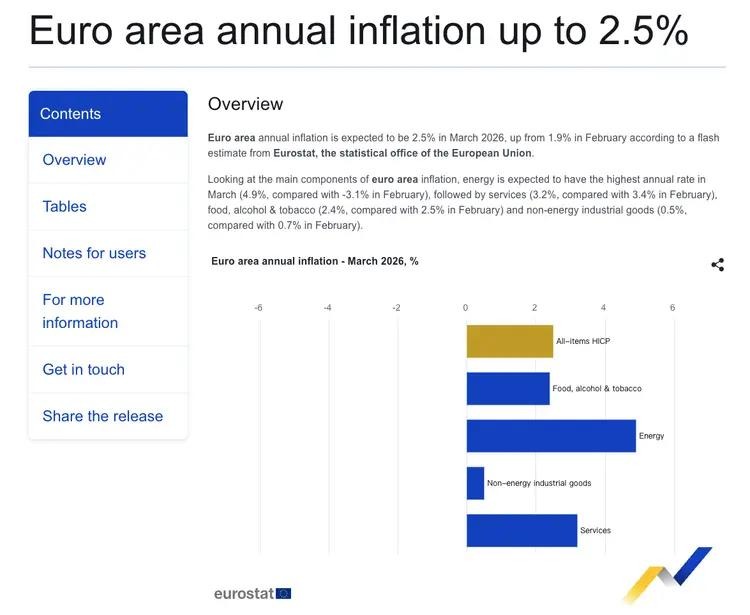

On March 31, 2026, Eurostat flash estimates showed eurozone consumer price inflation rose to 2.5 percent year-on-year in March, a sharp jump from 1.9 percent in February, marking the largest monthly increase since 2022 and breaching the European Central Bank‘s 2 percent target. Energy prices rose 4.9 percent year-on-year, up from 3.1 percent in February, driven by the ongoing conflict in the Middle East. Core inflation, which excludes food, energy, and tobacco, eased to 2.3 percent from 2.4 percent, and services inflation fell to 3.2 percent from 3.4 percent, indicating that domestically driven price pressures remain subdued even as external energy shocks mount.
At an emergency EU Energy Council meeting on April 1, Energy Commissioner Dan Jorgensen stated that gas prices in the bloc had risen by approximately 70 percent and oil prices by about 60 percent since the U.S.-Israeli military strikes on Iran began. Jorgensen noted that 30 days of conflict had already added 14 billion euros to the Union’s fossil fuel import bill. Eurozone consumer confidence plunged in March to its lowest level since October 2023, and the composite Purchasing Managers‘ Index fell to 50.5 from 51.9 in February, signaling near-stagnation in private sector growth. The OECD has cut its 2026 eurozone growth forecast to 0.8 percent and raised its inflation forecast to 2.6 percent. The ECB similarly revised its 2026 growth outlook downward to 0.9 percent and its inflation forecast upward to 2.6 percent.
On April 10, EU Economy Commissioner Valdis Dombrovskis warned the European Parliament that the Middle East war’s disruption of global energy supply chains has created a stagflation risk, with slowing growth and rising inflation occurring simultaneously. Within the ECB, views diverge: some officials favor early rate hikes to prevent inflation expectations from de-anchoring, while others warn against premature tightening that could inflict secondary damage on the economy. Under the ECB‘s “adverse scenario,” eurozone inflation could rise above 4 percent in the second half of 2026, while a “severe scenario” could push inflation as high as 6.3 percent in 2027. The confluence of energy-driven inflation and slowing economic activity presents the eurozone with its most challenging policy dilemma since the 2022 energy crisis.